← All posts
Web
iOS
AI
Normalized HRV still does what it did: it learns how your HRV moves with your resting heart rate from your own readings over the last 60 days, predicts what your HRV should be at this morning's pulse, and reports how far today sits from that. What changed is how that percentage is classified. Tempo used to bucket it into fixed bands (±5%, ±12%, ±20%) shared by every athlete, with labels that named a cause — Stressed, Fatigued, Unusual. Now the bands are measured in your own variability: the standard deviation of your recent readings around the fitted line.
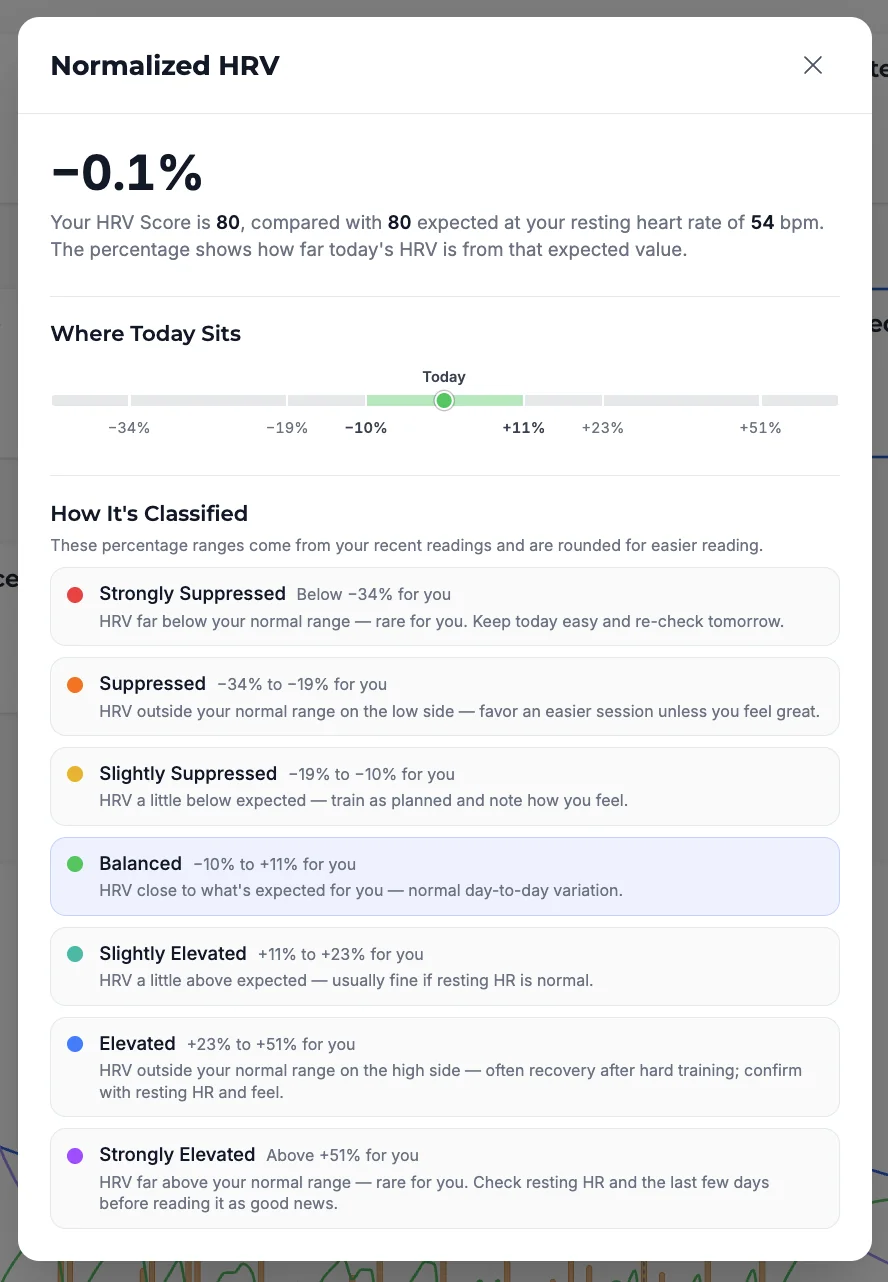
The seven states are Strongly Suppressed, Suppressed, Slightly Suppressed, Balanced, Slightly Elevated, Elevated and Strongly Elevated. Balanced is within half a standard deviation of expected — your usual range. Suppressed and Elevated sit one to two standard deviations out, and the Strongly states beyond two, which for most athletes is a handful of days a year. Because the yardstick is personal, the same −15% can be Balanced for an athlete whose HRV swings widely and Suppressed for one whose HRV is steady.
Tapping the card opens a redesigned detail view. It shows today's percentage, one sentence comparing your HRV Score with the one expected at today's resting heart rate, and a new Where Today Sits scale: a track split at the state cut-offs, your usual range shaded, today's marker in its state colour, and every cut-off labelled with your percentage. The How It's Classified legend translates each state into personal numbers too — for one athlete Balanced runs from −12% to +13%, and Elevated from +28% to +65%. Those ranges are asymmetric on purpose: HRV varies multiplicatively, so one standard deviation below expected is a smaller drop than one above is a rise.
While Tempo is still collecting the 30 days of paired resting heart rate and HRV it needs, the badge reads Calibrating and the detail view shows progress under Learning your usual range. When your resting heart rate and HRV are not coupled closely enough to fit a line — common when they come from different devices — Tempo compares today with your recent average instead, and the explanation says so.
Your AI assistant sees the same reading. Wellness data fetched over MCP now includes the Normalized HRV state, your usual range, the model in use and a 7-day trend in the same units, since weekly averages carry more of the training-status signal than a single morning.
Day-to-day HRV noise varies enormously between people, and a fixed percentage band cannot know how noisy you are. For an athlete whose one-standard-deviation spread is about 23%, the old ±5% Balanced band was under a quarter of a standard deviation wide: in one 30-day sample only 5 days landed in it and 13 landed in the two outermost bands. Ordinary variation was being reported as signal, and a textbook recovery rebound the morning after a hard day — resting heart rate down, HRV up — came back as "Unusual". Personal bands put Balanced where your normal days actually fall, so Suppressed and Elevated mean something when they appear.
The labels now describe the observation rather than a cause, because a single number cannot tell sleep debt from alcohol, illness, travel or a hard block. A high reading a day or two after hard training is usually a recovery rebound; a similar reading alongside weeks of fatigue can accompany overreaching; and at a very low resting heart rate HRV can plateau without anything being wrong. Each state's guidance points you at resting heart rate, the last few days of training and how you feel, which is where that distinction lives.
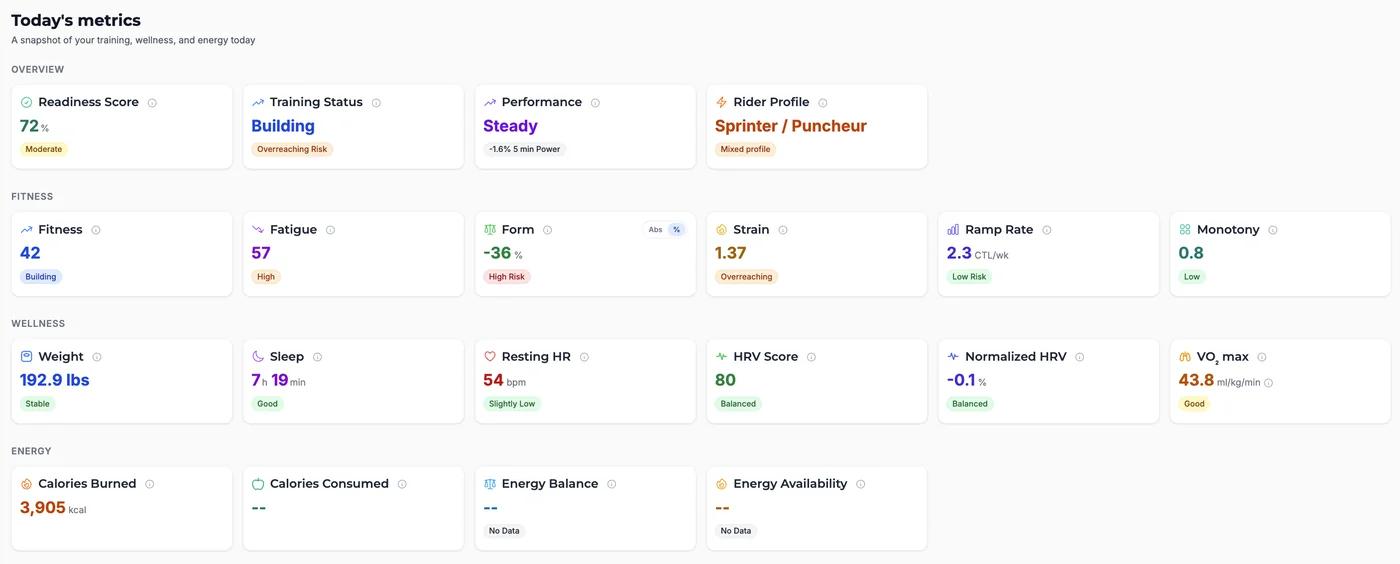
On the web, open Home and find Normalized HRV in Today's Metrics, or open Wellness and look at the key metrics cards. Click the card to open the detail view with Where Today Sits and How It's Classified.
On iOS, open Wellness and tap the Normalized HRV card to open the same detail sheet.
With Tempo connected to Claude or ChatGPT, ask: "Where does my HRV sit this morning relative to my usual range, and how has the week trended?"
Note: The state badge and the personalized sections of the detail view require a Premium subscription; the percentage and the calibration progress are visible to everyone. Normalized HRV needs both a resting heart rate and an HRV reading from the same night, so a scale that reports only resting heart rate does not contribute. The cut-offs follow the individual-variability approach of the HRV-monitoring literature, but they are display bands Tempo has chosen, not validated thresholds for training decisions — read the full method in the metrics glossary.